


🌊 "Messina on Onda" / 2025-1-IT03-ESC30-SOL-000348002 🎙️

What happens when a group of young people stops waiting for a space to be heard and decides to build it? Messina in Onda was born from this question and, over the course of twelve months, has transformed a simple idea, opening microphones to the voices of the city,into a youth newsroom, a training program, a network of collaborations, and a true media infrastructure made up of podcasts, videos, social networks, web apps, public events, and reusable educational tools.

🌐 Visit the Messina in Onda web app to explore episodes, schedules, and offers.
The "Messina in Onda" solidarity project, identified by the code 2025-1-IT03-ESC30-SOL-000348002 , was implemented as part of the European Solidarity Corps , Solidarity Projects action, with the support of the Italian Youth Agency and the Be The Change association . It was not conceived as a simple series of interviews, but as a participatory workshop: a place to learn to tell stories, listen, conduct research, use professional equipment, work as a team, and meet people who inhabit Messina in different ways.
The focus wasn't just on the final product. It was, above all, on the process: giving young people the opportunity to move from content consumers to informed creators, capable of choosing a topic, formulating a question, welcoming a guest, recording a conversation, editing it, subtitling it, publishing it, and bringing it into a real community.
💡 The idea: from a European experience to a stable space for Messina
The core of the project was formed through Be The Change 's local activities . A decisive step came during the follow-up to the youth exchange. “Oops!... I Wasted It Again!” , made in the Messina area in November 2024. On that occasion, some future members of the group took part in a podcasting session: not just a recording, but an experience in which technology, dialogue and non-formal learning met.
From there, a very concrete question arose: why not create a continuous, accessible, and youth-led space in Messina where we can talk about the city without having to present a perfect image? A podcast capable of embracing enthusiasm and frustration, belonging and the desire to leave, creativity, university, work, nightlife, identity, associations, and intercultural relations.
The initial intuition became a proposal for local solidarity: using media production as a tool for inclusion and active citizenship. The microphone would shape the conversations, but the true outcome would be everything that happened around the table listening, negotiating ideas, sharing responsibilities, and meeting with people outside the group.
👥 The group: different skills, shared responsibilities
Messina in Onda was built by a group with diverse profiles, histories, and skills. This diversity didn't remain a thing of the past: it became part of the working method.
Arlan Alin contributed to project management, internal planning, and the development of a sustainable workflow. Yana Sopp focused on social issues, sustainable development, and content quality. Amin Tahirli supported digital communication, promotion, and engagement with online audiences. Lamia Rahali worked on monitoring, feedback, and impact assessment, connecting participation, active citizenship, and personal growth. Mohamed Naim played a key role in group management, networking with associations and guests, intercultural mediation, and the ability to transform informal contacts into conversations and collaborations. Carim Gemelli strengthened the local dimension of production, participation in recordings, and content development.
Emanuel Caristi , the project's coach, worked alongside the group , guiding them through the process of organization, podcasting, storytelling, multimedia communication, public speaking, equipment use, editing, event management, evaluation, and Youthpass. Coaching didn't replace the young people's decisions: it offered tools, questions, and technical standards so that the group could gradually become more independent.
The distribution of roles was never rigid. Those starting out in communications could experiment with hosting; those more familiar with the technical side could work on welcoming guests; those who preferred to observe could contribute with research, logistics, subtitles, photographs, or feedback. Role rotation prevented any one person from becoming indispensable and transformed every production into a learning opportunity.
🛠️ Learning by doing: training, coaching and testing
The visible part of a podcast is the published conversation. The invisible part is made up of trial and error, listening, cables plugged and unplugged, rewritten outlines, meetings, and attempts that serve to build confidence. Messina in Onda has dedicated a substantial portion of its year to this very aspect.
The formally documented coaching covered twelve days and ninety hours, from initial planning to final evaluation. These included numerous group meetings, both in person and online: preparation, team building, research, technical learning, editorial definition, guest contact, material review, and event organization.
In the first phase, the group clarified objectives, roles, schedule, and collaboration rules. They then worked on active listening, interview structure, storytelling, constructing open-ended questions, time management, guest consent, and handling sensitive situations. Technical training covered microphone operation, XLR connections, gain, headphone listening, multitrack recording, lighting, framing, and audio-video synchronization.
The main set was designed for three voices, featuring RØDECaster Pro IIs, RØDE PodMic USB microphones on articulated arms, Shure SRH440A headphones, and a Behringer XM8500 as an additional mic. Filming was done with two smartphones serving as Camera A and Camera B, supported by tripods, softboxes, and LED lights to ensure visual continuity. DaVinci Resolve Studio and Adobe Premiere Pro were used for the full episodes, while CapCut Pro made it quicker to edit the vertical content for social media.
Sessions that didn't produce a published episode weren't considered failures. They served to learn how to speak into a microphone, adjust different levels for each voice, recognize an unusable recording, improve pacing, rephrase a question, or address an unexpected issue. In an educational project, even a file that doesn't make it online can document a skill acquired.
🧭 From editorial meeting to publication
Each episode began long before the REC button was pressed. The group gathered ideas from their own conversations, comments received, and from associations and people they met in the area. The ideas were discussed, evaluating their relevance, feasibility, diversity of perspectives, and the availability of a guest.
Once the topic was chosen, a brief was prepared: the conversation's objective, audience, language, key questions, potential sensitive points, and materials to review. This was followed by contact with the host, an explanation of the format and consent, a technical rehearsal, and the assignment of roles for recording, photography, video, monitoring, and reception.
After recording, post-production began. Audio and video were copied and organized, tracks synchronized, technical errors corrected where possible, and the editing was constructed while preserving the essence of the conversation. The group produced a master from which to extract full episodes, excerpts, trailers, vertical reels, and subtitled materials. The content was produced in Italian and English or made accessible through subtitles, so it could be distributed internationally.
This flow taught us something that goes beyond podcasting: quality comes from organization. Naming files consistently, maintaining consensus, knowing who's responsible for the next step, and archiving a clean master are unspectacular skills, but they're essential for making a collaborative project reliable and replicable.
🎧 Many episodes, many Messinas
The production has resulted in over twenty edited and published episodes, available on YouTube and Spotify and also collected in the project's web app. Rather than following a single thematic thread, the series has chosen to build a mosaic: each episode adds a perspective on the city, the young people who live there, and the questions that permeate their daily lives.
"Why are we leaving?" explores the relationship between young people, opportunity, and the desire to leave. "Nightlife in Messina" and "Is Messina Boring?" question two recurring labels without offering pre-packaged answers. "Why Choose Messina?" instead attempts to look at the city through the reasons of those who decide to stay or choose it.
Local creativity emerges in episodes like "No Talent Needed: Cult of Ithalia," "Messina as a Canvas: Cult of Ithalia," "Rap or Freestyle?", "From Bedroom Bars to Stretto Cypher," and "Stretto Cypher." Photography, clothing, music, and urban culture become different ways of interpreting the region. "Just Click a Button?" draws on photography to explore the less visible side of Messina; "What Are You Wearing?" uses style as a gateway to identity and representation.
Other episodes focus on belonging, relationships, and care. "Where Do I Belong?" explores the search for place and community. "The World in One Room" focuses on the intersection of cultures. "Children Don't Come with Manuals" explores parenting and social expectations. "Debate Without Drama" reflects on how to sustain a discussion without turning it into conflict. Episodes like "Momo Takes the Mic" and "Why This Podcast? Meet the Voices" also showcase the group, their personal motivations, and a behind-the-scenes look at the project.
Publishing across multiple platforms wasn't just a matter of duplication. YouTube allowed us to enhance the visual language and subtitles; Spotify offered a listening experience closer to podcast format; reels and short excerpts opened quick entry points; the web app brought together episodes, schedules, proposals, and materials in a unified environment.
🌍 When the podcast leaves the studio
Messina in Onda truly worked when the microphone stopped being perceived as an object reserved for those who "already knew how to speak." During the project, more than one hundred young people directly experienced the podcast through training, rehearsals, recordings, interviews, and public activities. Others participated as spectators, observers, guests, collaborators, or people interested in joining the group.
A particularly significant moment was the final public event at the Volta Pagina Literary Café. More than one hundred young people from Messina met with the team and representatives of youth organizations, transforming the final presentation into an evening of conversation and new connections. The project was presented not as a finished product, but as a platform that could continue to host ideas, people, and collaborations.
Over the course of the year, the dialogue involved or reached out to a broad network: Crafters Bridge, Cult of Ithalia/iThalia Art Community, student groups affiliated with the University of Messina, the Community of Sant'Egidio, Friends of the T. Cannizzaro Library, Deep Healing Talks, Messina Pulse, Invict Academy, Aruncity Runners, and numerous other organizations active in the area. The level of collaboration varied from case to case:hospitality, event participation, referrals, content sharing, networking, but the overall effect was to broaden the scope of the project.
The podcast was also used by the young people in the core team as a non-formal education tool in international activities and meetings. Taking the equipment and method outside the usual setting demonstrated the format's adaptability: a recorded conversation can become an intercultural listening exercise, a group feedback session, a testimonial, or a way to engage people who wouldn't naturally choose a traditional workshop.
🤝 Participation must be possible: remove obstacles
A youth project can claim to be open and yet remain, in reality, accessible only to those who already have time, money, mobility, and security. For Messina in Onda, inclusion was also an organizational issue.
Thanks to the support of the European Solidarity Corps , the group was able to overcome very real obstacles: car travel, shared meals during long days, snacks, drinks, and food on site, logistical requirements related to registration, and support for those who would have had difficulty participating consistently. These were not marginal factors. Eating together after hours of work, being able to get to a meeting location, or not having to pay a fee upfront can determine who stays involved in a project and who is forced to drop out.
The same attention was paid to guests, spectators, and young people interested in observing or contributing. The activities offered multiple ways to participate: speaking at the microphone, working behind the scenes, attending, suggesting a topic, helping with an event, or participating online. The use of Italian and English, subtitles, the possibility of alternating presence and remote connections, and role rotation helped reduce linguistic, geographical, and self-confidence barriers.
This experience has left us with a replicable principle: inclusion isn't a phrase added at the end of a project, but something planned from the beginning. It requires time, resources, listening, and a willingness to adjust the format when someone doesn't fit the expected format.
📡 Not just one channel: a media infrastructure
One of the most striking results is the scale of the ecosystem it has built. Messina in Onda isn't just a playlist. The project has developed a visual and audio identity, an intro and outro, original soundtracks, cover art, templates, a production archive, and a coordinated presence across multiple environments.
The profile Instagram @messinainonda collected around one hundred posts and hundreds of stories and reels created by the students: not just promotions for the episodes, but also rehearsals, faces, questions, snippets of events, and editorial life. TikTok offered an additional space for short formats. Spotify and YouTube hosted the full episodes, while the web app brought together listening, a calendar, comments, topic suggestions, tools, and access to the various channels.
📲 Follow the editorial team on Instagram and TikTok · 🎧 listen on Spotify · 🎬 watch on YouTube · 🌐 explore the web app
This infrastructure has two values. The first is public: it makes the project traceable and allows anyone to access it from the platform they already use. The second is organizational: it preserves memory, files, formats, and relationships, preventing everything from disappearing once the funding expires. The channels have become the group's shared assets, ready to welcome a second season and new young people interested in contributing.
From Practice to an Open Method: "Podcasting for Change"
The experience gained wasn't just shared by those who participated. The team transformed it into " Podcasting for Change ," a practical guide in Italian and English designed for youth groups, associations, youth workers, educators, and communities looking to start a participatory podcast.
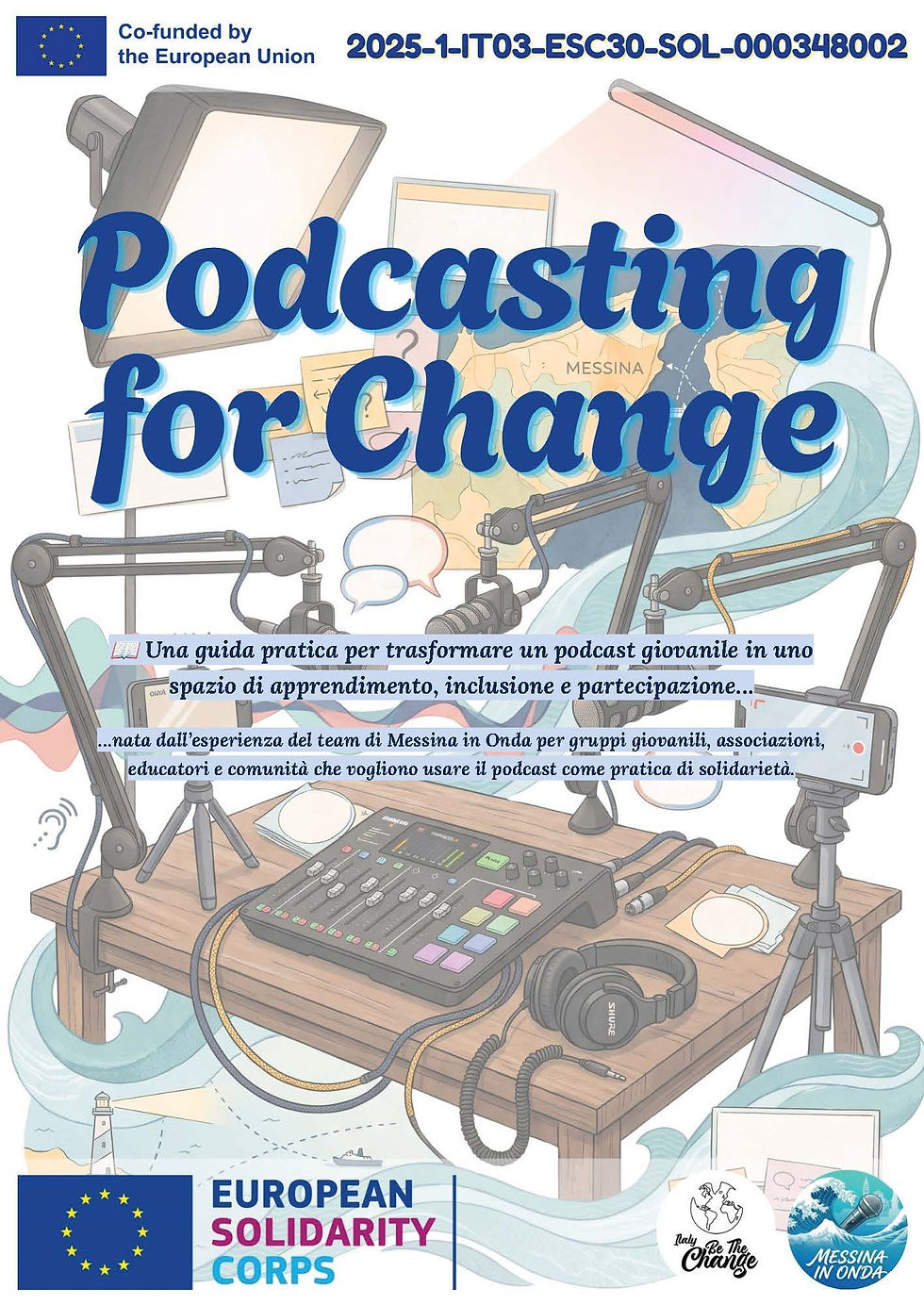
The guide takes the reader through twelve steps: from understanding the region and building a group to choosing themes; from taking care of the guest and obtaining consent to the technical set; from recording to post-production, subtitling, publishing, events, evaluation, and Youthpass. It also contains seven printable worksheets for planning an episode, preparing consent, checking the recording, organizing an event, and facilitating the debrief.
The toolkit doesn't propose a single model to copy. It distinguishes between what is essential: listening, safety, clear roles, backup, consensus, feedback and what can be adapted to available resources. Even a group with simpler equipment can apply the method, as long as they consider accessibility, process quality, and editorial responsibility.
Publication in the SALTO-YOUTH Toolbox has given the result a European dimension. The Italian and English versions can be downloaded and used free of charge, transforming an experience born in Messina into a resource for other youth work contexts.
📘 Download “Podcasting for Change” in the SALTO-YOUTH Toolbox .
✨ What has changed
The most immediate results are visible: published episodes, channels, photographs, events, a web app, a guide, an archive, and a network of contacts. The more profound ones emerge in the way young people describe what they've learned.
🌐 Explore episodes and materials in the web app
The final monitoring revealed widespread acquisition of new technological skills and a willingness to reuse them, along with increased ability to work in a team, cooperate with diverse people, recognize discrimination, and transform an idea into a community activity. Autonomy, responsibility, adaptability, communication, and confidence in speaking up improved. Preparing for the Youthpass helped recognize that conducting an interview, solving a technical problem, or negotiating an editorial decision are transferable learnings beyond the project.
🌊 A New Wave of Volunteers and Podcast Episodes 🏝️ https://padlet.com/MessinaInOnda/socialwave-who-we-are-7hp66kssaepsj6x
Some effects have already led to new trajectories. The experience has helped inspire personal journeys like TheSmileyCurly , the narrative space created by Lamia. Requests have arrived to participate in training, propose guests, receive support, or join the group. A new group of young people has expressed interest in continuing the project, and planning for a second season has given concrete form to the continuity.
Above all, Messina in Onda has demonstrated that a medium can become a social infrastructure. An episode connects the host and the guest; a recording engages technicians, photographers, organizers, and the audience; an event connects associations; a reel reaches those who wouldn't have started a forty-minute podcast; a guide allows another group to start over elsewhere.
The funding had a finite duration. The skills, channels, relationships, and desire to continue did not.
🔗 Explore Messina on Air
Messina in Onda is a solidarity project carried out with the support of the European Solidarity Corps and the Italian Youth Agency , with the accompaniment of Be The Change .


Comments